Mayank SainiAI ENGINEER

I build systems
around agents.

I'm Mayank, an AI engineer building agent orchestration and financial-close systems. I'm curious about what makes an agent useful beyond a single answer: the tools it can use, the context it keeps, and the decisions we can inspect.

IIT Kanpur PwC US R&D Mirian AI

Selected work.

From the orchestration layer
to the operational details.

I'm interested in
Personal project · Prototype

Relay

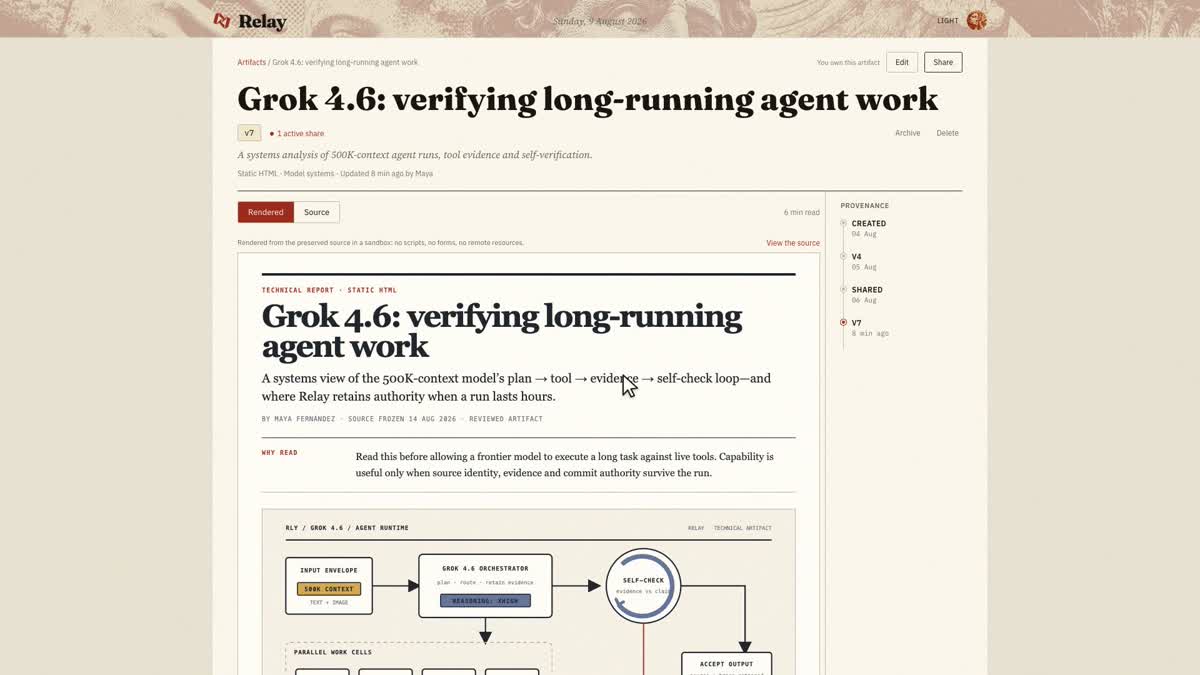
A place to share technical artifacts with their source, version history and access rules intact.

Explore the prototype

I built the interactive product prototype and launch film, and designed the sharing, rendering and agent-access architecture.

Explore
Artifact reader · source · access rules
Watch
A 52-second tour of the prototype
Status
Prototype; production platform in progress
Mirian AI · 2026—present

Agent-enabled
financial close.

Owning FinClose end to end: financial-close agents and the common operating data layer they work from.

Read the engineering decisions

Make each action inspectable.

Agents prepare, reconcile and explain close tasks. Scoped access, source lineage and reviewable actions make it possible to check a result before it changes a financial workflow.

Build a reusable data layer.

ERP and bank feeds flow into a common operating layer, so each new agent can work from consistent source data instead of another custom integration.

High-level account of my work. Client data and implementation details are private.

Walk through the architecture
ERP feedBank feedSource documents
ONE OPERATING LAYERData with its history intact.
PrepareReconcileExplain
Human review
Illustrative system view
PwC US R&D · Senior AI Engineer · 2024—2026

One orchestration layer.
Many enterprise tools.

LangGraph orchestration connecting 50+ AI tools from Advisory, Tax and Assurance through MCP and A2A.

Read the engineering decisions

Keep delegation explicit.

I worked on a LangGraph supervisor architecture with MCP and A2A, letting an orchestration layer delegate work to specialised tools.

Control what the next step sees.

Pruning, compaction and summarisation help manage long-running context. Redis checkpointing, LiteLLM caching and Langfuse tracing support state, cost and inspection.

An account of my contribution, not a public reproduction of an employer platform.

Walk through the architecture
CONTEXT → TOOLS → STATEKeep the thread.
MCPDocumentsAPIsToolsState
Research · arXiv preprints

The right model
for the right task.

Our 2026 preprint reports 67% lower cost against its matched hierarchical baseline across 2,847 queries.

Explore the research

Our research studies learned routing among specialised models and supervisor-based tool orchestration across modalities.

The 2026 preprint reports a 67% cost reduction against its matched hierarchical baseline, evaluated across 2,847 queries. The reported result is specific to that study.

Read the methodology on arXiv
A query arrives.
TextImageAudioDocument
Route by capability.Then evaluate the result.
Two public preprints

Showing all 4 projects.

Research.

Machine-learning research.
Methods, experiments and trade-offs.

2026 · arXiv preprint

One Supervisor, Many Modalities

Adaptive Tool Orchestration for Autonomous Queries

2025 · arXiv preprint

Towards Resource-Efficient Multimodal Intelligence

Learned Routing among Specialized Expert Models

Explore an agent workflow Interactive illustration

A closer look at the system.

Follow a synthetic task through tools, context, routing and review. This is an authored illustration of the decisions around an agent.

A task, through the system.Illustrative demo
REQUEST

Find the evidence in a document and an image. Explain the answer.

READY

Pick a task and run it. Select any node to inspect its job.

Synthetic inputs. Browser simulation. No live models or employer systems.

The interesting part is everything around the model.

How a task is split, which tool is allowed to act, what context survives, and when a person needs to review the result. That's where I spend my time.

See it in the work

Questions I keep
coming back to.

How should search change when agents do the browsing?

I'm interested in evals that explain where a search went wrong, evidence that survives the hand-off, and keeping instructions in a retrieved page from hijacking the task.

What was here before “here” existed?

How the universe began, what “before” even means, and whether this is all a simulation. I have a few questions for whoever wrote the spec.

A little background.

I like getting into the details between a promising model and a system people can use. Building the prototype, reading the research and testing the assumptions are all part of that for me.

I studied Electrical Engineering at IIT Kanpur, with a minor in Machine Learning. Before my work at PwC and Mirian AI, I built a Smart TV recommendation project during an internship at Samsung R&D.

Explore my GitHub

The working toolkit

Orchestration
LangGraph · LangChain · MCP · A2A
Runtime & state
Python · FastAPI · Redis · FastMCP
Models & visibility
LiteLLM · RAG · Langfuse
Infrastructure
AWS · Azure · Git

Tools matter when the system around them works.

On my own time.

Side projects, agent research
and interfaces worth thinking about.

I enjoy making small tools, reading about how agents work, and exploring how an interface can make a technical idea easier to understand. A few things I keep working on: